If you know Web3, you know OpenSea. Since its launch at the end of 2017, the NFT market has to a large extent been a typical representative of Ethereum and the crypto art world, and it has sufficient numbers to prove this.
According to data from Dune Analytics, OpenSea's total historical trading volume was just under $41 billion. In the long run, KnownOrigin, one of OpenSea's competitors launched at about the same time, has a total transaction value of just over $30 million.
After dominating the market for nearly six years, OpenSea has the same impact on the NFT ecosystem as any project, artist, or builder. However, this huge impact is not always good, as the company is increasingly starting to conflict with members of the NFT community over some fairly significant issues related to Web3.
Especially in the past six months, the market has faced some challenges that are still being addressed, and it is also the first true competitor to have the opportunity to replace it as the leader of the NFT market. With this in mind, here is all the information you need to know about OpenSea.
What is OpenSea?
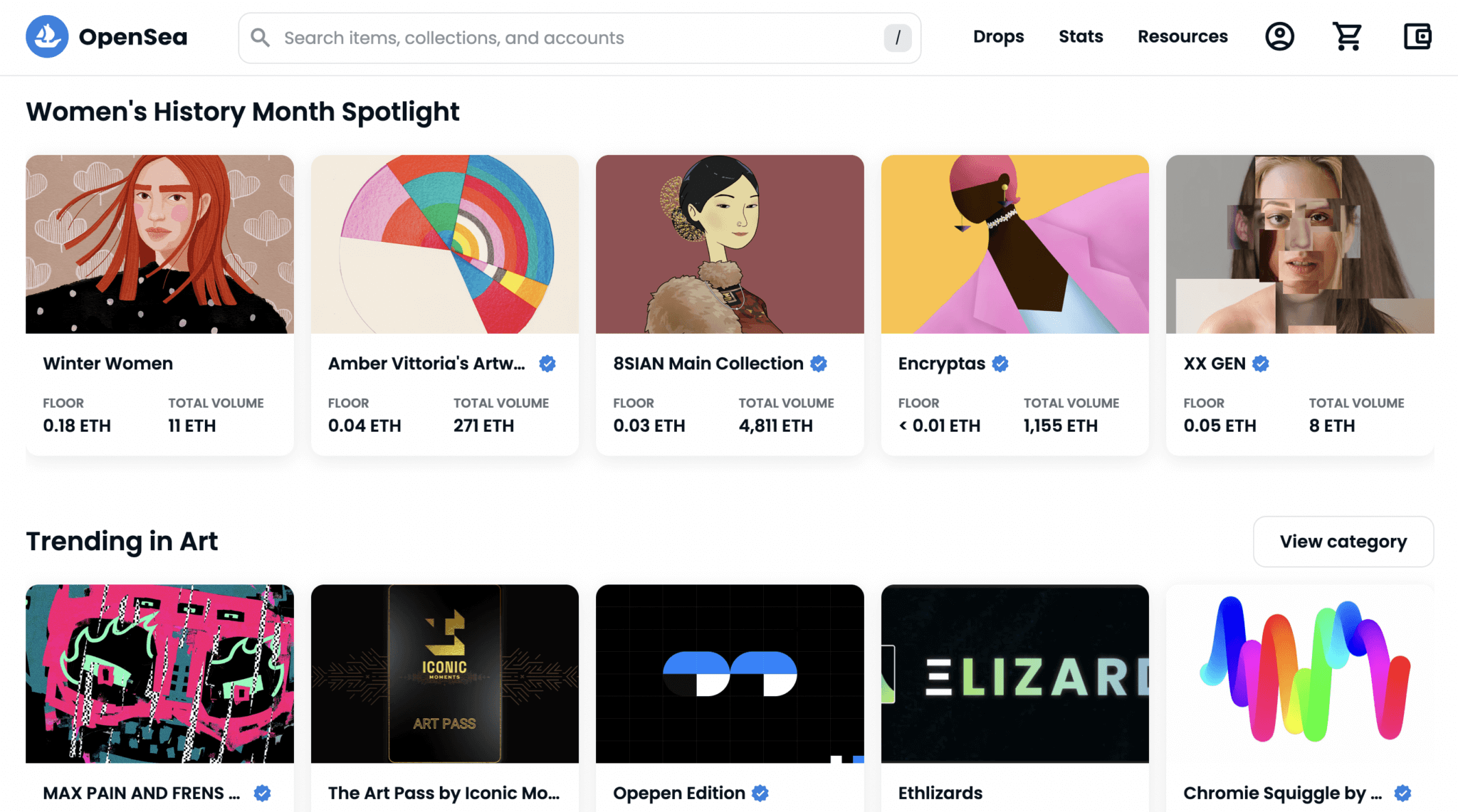
OpenSea is currently one of the most well-known peer-to-peer NFT markets. Users can purchase, sell, trade, and create various types of NFTs on the platform, from photography and PFP to games, member tokens, and art projects.
The landing page for OpenSea contains 10 series titles and information.
Letter of Credit: Gonghai
OpenSea is a versatile player in the NFT market. It is easy to navigate and provides a limited but universal set of analysis tools and sorting options for users who want to dig deeper into collection history or the rarity of NFT features. The platform is not focused on a specific niche market for Web3 users, but rather a one-stop service for a wide range of Web3 enthusiasts, including novices, experienced traders, and retail NFT buyers with low trading volumes.
The Rise of OpenSea
It is difficult to overstate the rise of OpenSea over the past few years. The market was founded in 2017 by software engineer, entrepreneur Devin Finzer, and programmer Alex Atallah. By the summer of 2021, the market capitalization had reached $1.5 billion. By January 2022, after the company raised $300 million in Round C financing, this number had soared to $13.3 billion.
Although NFTs have existed in some form since 2011, even in 2017, they have not reached a turning point and have gained significant appeal in the eyes of the public. During the process of creating OpenSea, Finzer and Atallah discovered the need to establish a platform that would serve as the focus of the essentially different Web3 enthusiast communities at the time.
A spokesperson for OpenSea said in an interview with NFT, "Initially, Devin and Alex set out to create a market that brought together fragmented communities in the early days of nft.". "While accepting a range of potential outcomes, the benefits always exist: becoming a destination where people can interact with NFT, thereby exploring the new economy on the Internet."
Since the platform's launch in late 2017, even considering the recent cryptocurrency winter of Web3, this economy has grown significantly. As of September 2022, the transaction volume in the Ethereum NFT field reached 8.22 million ETH ($11.5 billion). In addition, a recent report from Verified Market Research, a research and consulting company, predicts that the market value of the NFT industry may reach 231 billion dollars by 2030.
OpenSea has played a crucial role in helping the market mature. From May 2021 to November 2022, the platform was responsible for most of the transaction volume in NFT space.

OpenSea Tools and Features
OpenSea regularly introduces new features and tools on the platform, all aimed at increasing trust in the platform, user security, and improving the infrastructure of a larger ecosystem.
The latest major update to the platform occurred in June 2022, with the launch of Seaport, a Web3 market protocol that enables users to buy and sell NFT more securely and efficiently. Prior to Seaport, OpenSea used Wyvern, a less efficient protocol created by third parties. In contrast, Seaport has reduced redundant transmissions, reducing users' natural gas costs by 35%, according to a company blog article on development. Seaports are open source; OpenSea does not control or operate it, and the company encourages smart contract developers to work with them to improve the protocol.
Last year, the market introduced several features, including a forgery detection system, a method to hide suspicious NFTs from being transferred to users' wallets, and the ability of creators to launch a dedicated delivery page called Drops directly on OpenSea. But not all product launches have received favorable reviews.
OpenSea's Royalty Dilemma
Over the years, OpenSea has been rolling out or changing the products and services it provides, which are related to Web3's most pressing issues, but are not always elegant. The platform often conflicts with artists and creators who condemn the market as an affront to the health of the NFT community and the individuals who form its cornerstone.
These criticisms can be difficult to balance fairly. Due to its position and long history in this field, OpenSea is easily targeted, regardless of whether its critics' arguments are legitimate or not. In any case, like every market in the ecosystem, the company has had its own difficulties and shortcomings over the years. The platform has been working to develop fair and effective stolen goods policies, with a history of website functionality issues during periods of high traffic and subsequent high growth, and has adopted a fairly centralized approach to implementing rules related to its user base.
But the most striking issue with OpenSea in the Web3 community is its inconsistent stance on creator royalties. Royalties (also known as creator fees) allow artists to receive compensation for their work that goes well beyond their initial sales range, thereby taking a slice of the profits each time NFT changes hands. Royalties have helped artists and builders in Web3 create a rich, diverse, and prosperous art ecosystem, playing an important role in its sustainability and providing an important source of income for funding future projects.
Until the recent development of on-chain execution tools, royalties were initially not enforceable at the technical level. Even so, some collections on OpenSea are not created on scalable smart contracts, which prevents them from using newly developed tools. However, for collections based on upgradeable contracts, these royalty payments are implemented and enforced through these new tools by markets that promote NFT trading.
Until recently, OpenSea had done a lot of work supporting artists in this way. As of October 2022, this market is the platform that pays the most royalties to creators. In November of the same year, the market announced that it would launch a new collection tool to enforce royalties on its platform.
This announcement marks the first breakthrough in OpenSea's on-chain solution for royalty enforcement. Although this has been hailed as a positive and beneficial initiative for creators, users are disturbed by the fact that this royalty enforcement will not apply to existing collections on OpenSea, which have helped the platform become a leading Web3 force.
Response from the NFT community
Against the strong opposition of almost every well-known NFT artist and project leader in this field, OpenSea announced that it would continue to levy creator fees on traditional collections. Many people at the time believed that this was both a victory for creators and an event in Web3 that promoted the labor union movement.
However, in February 2023, OpenSea once again changed its stance on royalties. In a Twitter post, the company announced that it would transfer its collections (the vast majority of collections on its platform) that do not use on-chain law enforcement tools to optional royalties. Many artists in the community are once again dissatisfied with this.
OpenSea claims that significant changes in market dynamics are the main reason for its shift to optional royalties on the platform, which has some credibility. "If collectors in Web3 can be avoided, they don't want to pay royalties at all, and the market must listen to the opinions of collectors who make up their target audience.". This trend is not theoretical - the market is increasingly abandoning royalty enforcement, and zero royalty platforms such as Blur have begun to extract significant transaction volumes from OpenSea, usurping most of the company's previously held market share.
OpenSea and Blur
The rise of Blur is one of the most important developments in the history of the NFT market, which is closely related to the goals OpenSea has attempted to achieve through royalty actions in recent months. Blur rewards users by airdropping its own tokens for free, thereby attracting a small but powerful group of professional traders. This strategy has proven to be widely effective in its current goal of optimizing market share. Since November 2022, Blur has either kept pace with OpenSea or completely surpassed it in terms of transaction volume (although OpenSea still maintains a high number of active users).
A 1980s dragon style design with the letter "$BLUR" on a coin located in the center of a grid.

Blur. Credit: Fuzzy
However, OpenSea may have contributed to some of the market shifts it now laments. Its recently announced royalty policy forces creators to choose between earning full royalties on OpenSea or Blur, and to set the royalty as optional when a collection is detected for trading on a royalty selectable platform. Ironically, it is OpenSea's own seaport that has allowed Blur to avoid this policy, attracting more users to Blur's shores. In any case, this puts creators and collectors in an uncomfortable position.
OpenSea's attempt to maintain royalties as much as possible is commendable, and the platform is not as much an artist hating behemoth as some people claim. But when it competes with others for the dominant position in the NFT ecosystem, many people believe that one of the founding principles of Web3 is to empower artists and appropriately compensate for their work, while creators are caught in the middle. This is a race to the end.
Ultimately, as some people have said, the Web3 platform may be more concerned about gaining market share because the success of this goal enables them to obtain more financing through venture capital. Either way, the current market dynamics are incompatible with the artist community that creates wealth from the NFT ecosystem, and they sincerely believe that Web3 technology has the ability to create a fairer future for creative people.
Decentralization challenges
OpenSea has been criticized for not having simple solutions to several issues. One example is the platform's stolen goods policy, which previously led to penalties for users who inadvertently purchased stolen NFTs in the market. It is worth noting that OpenSea has received feedback from the community, so it has updated its policies to better curb theft and improve the accuracy of stolen item reporting. It also implements malicious URL detection and deletion, as well as a system designed to prevent the resale of stolen items.
Although some people believe that OpenSea can and should develop as fair and effective policies as possible for stolen goods earlier than before, it is no exaggeration to say that dealing with security issues in a decentralized world remains an imprecise science, especially when an organization attempts to ensure compliance with the law in the United States.
In March 2022, the platform encountered problems in how to meet the requirements of the United States sanctions law, which also fell into this category. It is difficult to strike a balance between a largely anonymous international user base and potentially devastating legal consequences.
The Meaning of Decentralization in Web3

Credit: Now it's NFT
All these issues are under the banner of a fundamental principle of Web3: Decentralization, which means that the broad power to make changes that affect the community should be distributed throughout the community, not to individual individuals or organizations. Large NFT platforms like Opensea are in an enviable position here. Anyone who has worked in the NFT field for more than a few weeks will be familiar with the call for a truly decentralized market. These appeals, regardless of their original intention, are often inadequately considered.
OpenSea believes that centralized debate is a crucial and convincing debate, like every controversial issue in this field, which will evolve over time and require a method that can be adjusted when necessary. Although it is easy to think of OpenSea as a centralized entity, it is also worth noting that most Web3 entities are.
Concentration is a spectrum. For example, Nifty Gateway is a hosted platform that stores users' NFTs in their wallets, and users need to extract NFTs from their wallets to conduct transactions on other platforms. Even the founders of SuperRare recognize that decentralization is an ongoing work, and "decentralization through a centralized approach" may be one of the best ways to achieve the commitment of this particular principle of Web3.
OpenSea believes that in environments full of risks and unknowns, it is sometimes necessary to take coordinated actions at some authoritative level to maintain the smooth operation of things and the safety of users. Web3 is an unstable environment that changes over time. It is unreasonable to expect anyone to follow and respond perfectly; It is unreasonable to expect the same from a large, multi billion dollar organization.
The Future of OpenSea
This is not to say that OpenSea has done a great job in what the NFT community often accuses it of; If it wants to maintain its position as the top market for Web3, it must do so. It owes creators - not just collectors - innovation that they can use and defend their rights as Web3 citizens. Similarly, it can do more to clearly communicate abrupt policy changes to users and implement decisions in a more transparent and accurate manner.
In a blog post in November 2022, Chief Executive Officer Devin Finzer emphasized the company's approach to Web3 evolution: "We believe that ultimately, the real economy will shift in this direction. One day, almost everything we own may be owned and transferred on the blockchain in the form of NFT.". "We firmly believe that this technology will ultimately provide power to the largest market on Earth and fundamentally change society. This is our vision of solidarity at OpenSea."
All this sounds like rhetoric about money. But rhetoric is easy; It remains to be seen how the market decides to implement this vision fairly, while facing rapidly changing market dynamics, increasing competitive pressure, and the movement of creators to unite around royalty issues.


0 commentslist